
/ CONDITIONS / BUNIONS
Bunion Treatment
Conservative management and minimally invasive surgical correction for bunions in San Antonio, TX — with options designed for a faster recovery and a lasting result.
Andrew Gunter, DPM.
Call (210) 581-9800
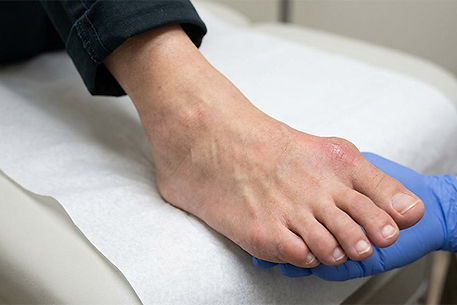
What Is a Bunion?
A bunion — medically termed hallux valgus — is a structural deformity of the first metatarsophalangeal joint at the base of the big toe. It develops when the big toe progressively drifts toward the second toe, causing the metatarsal head to protrude on the inside of the foot and the joint to deviate from its normal alignment.
Bunions are among the most common foot deformities in adults, affecting an estimated 23% of adults aged 18 to 65 and over 35% of adults over 65. They are more prevalent in women, though the deformity occurs in both sexes. There is a significant hereditary component — the foot structure that predisposes someone to bunion formation tends to run in families.
Bunions are progressive. Once the deformity begins, it typically worsens over time without intervention. The rate and severity of progression varies significantly between individuals. Conservative measures can manage symptoms and slow progression, but they do not correct the underlying structural deformity.
Many patients tolerate bunion discomfort for years — sometimes decades — before seeking care. By the time they present for evaluation, the deformity is often more advanced than it would have been with earlier intervention. Dr. Gunter evaluates every bunion individually, assesses severity on weight-bearing X-ray, and recommends the most appropriate treatment approach for your specific situation — whether that is conservative management, minimally invasive correction, Lapiplasty, or other traditional surgical repairs.
COMMON SYMPTOMS
-
A visible bony bump on the inside of the foot at the big toe
-
Pain or soreness at the big toe joint
-
Redness, swelling, or inflammation at the joint
-
Difficulty finding comfortable footwear
-
Corns or calluses where the first and second toes overlap
-
Restricted or painful range of motion at the big toe
-
Numbness or burning at the big toe joint
WHO IS MOST COMMONLY AFFECTED:
-
Adults with a family history of bunions
-
Women more frequently than men
-
People who wear narrow or pointed footwear regularly
-
Adults with flat feet or hypermobile joints
-
Patients with inflammatory arthritis
-
Adults over 40 — prevalence increases with age
Bunion Treatment Options
Treatment depends on the severity of your bunion, how much it affects your daily life, and your personal goals and timeline. Dr. Gunter discusses all appropriate options honestly — beginning with the least invasive approach and progressing only when it is genuinely in your best interest.
Conservative management
Wider footwear, bunion padding, and custom orthotics cannot reverse or correct the deformity but can significantly reduce pain and slow progression. Custom orthotics designed for your specific foot mechanics offload the first metatarsal joint and reduce the forces driving further deformity. Appropriate for patients whose bunion is not yet significantly limiting daily function.
Minimally invasive bunion correction
A modern surgical technique using small percutaneous incisions — typically a few millimeters — to correct the underlying bone deformity with significantly less soft tissue disruption than traditional open surgery. Smaller visible scarring, reduced postoperative discomfort, and a faster return to normal footwear and activity compared to traditional bunionectomy. Not every bunion is a candidate — Dr. Gunter evaluates eligibility individually.
Traditional bunion surgery (bunionectomy)
Open surgical correction of the bunion deformity — appropriate for moderate to severe cases, particularly those involving significant joint incongruity or arthritis that cannot be fully addressed with minimally invasive techniques. Dr. Gunter performs traditional bunionectomy when it is the most appropriate option for the patient's specific deformity. Lapiplasty is a newer iteration of a traditional bunion surgery that Dr. Gunter offers to patients with certain criteria.
Joint preservation vs. joint replacement
For bunions complicated by significant arthritis at the big toe joint — hallux rigidus — Dr. Gunter evaluates whether joint-preserving procedures or, in advanced cases, first metatarsophalangeal joint replacement is the most appropriate surgical approach. This decision is made based on X-ray findings and functional status.
Related conditions: Hallux limitus · Hallux rigidus · Hammertoes · Custom orthotics
Why Patients Choose Dr. Gunter
✓
5,000+ Patients
Helped
✓
Same-Day
Appointments
Available
★
5.0 Average
Google Rating
✓
100% Focused
on Foot & Ankle
Frequently Asked Questions — Bunion Treatment
Ready to talk about your bunion?
Same-day appointments available.
Whether you want to explore conservative options, learn whether you are a candidate for minimally invasive correction, or simply get an honest evaluation of where your bunion stands — Dr. Andrew Gunter, DPM is here. Serving San Antonio and surrounding communities. Most insurance plans accepted.
Call (210) 581-9800