
/ CONDITIONS / LISFRANC INJURY
Lisfranc Injury
Lisfranc injuries are among the most frequently misdiagnosed foot injuries in medicine. What appears to be a midfoot sprain on an initial evaluation — swelling, bruising, and pain after a twisting injury — is sometimes a Lisfranc fracture-dislocation that requires surgical repair to prevent permanent midfoot instability, arthritis, and chronic disability. The difference between the two diagnoses is not always obvious, and the consequences of a missed Lisfranc injury can be profound.
Andrew Gunter, DPM — San Antonio, TX.
Call (210) 581-9800

What Is the Lisfranc Joint?
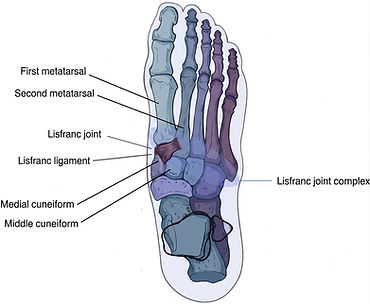
The Lisfranc joint complex — named after the French surgeon Jacques Lisfranc de St. Martin — refers to the tarsometatarsal (TMT) joint complex: the articulations between the metatarsal bases and the tarsal bones (primarily the medial, middle, and lateral cuneiforms and the cuboid) in the midfoot. These joints form the architectural keystone of the longitudinal arch of the foot.
The Lisfranc ligament itself is a strong ligament that runs obliquely from the medial cuneiform to the base of the second metatarsal, anchoring the second metatarsal — the 'keystone' of the TMT complex — in its mortise. The second metatarsal is recessed between the first and third metatarsals in a mortise configuration that provides inherent osseous stability. Loss of the Lisfranc ligament disrupts this stability.
Lisfranc injuries span a spectrum from subtle ligamentous sprains — where the ligament is partially torn but the joint remains stable — to complete ligamentous disruption with frank dislocation of one or more metatarsals. The severity of the injury determines the management and prognosis.
SIGNS YOU MAY HAVE A LISFRANC INJURY:
Patients with metatarsal fractures often report being told they 'just sprained' their foot. Midfoot pain following trauma or a period of increased activity warrants imaging — not every painful foot is a sprain, and the consequences of a missed metatarsal fracture can be significant.
LISFRANC INJURY SYMPTOMS:
-
Midfoot pain following a direct blow, fall, or twisting injury
-
Swelling and bruising on the top of the foot
-
Difficulty or inability to bear weight
-
Pain that is localized to a specific area of the foot when pressed
-
Gradual onset of midfoot pain that developed with increased walking, running, or activity — possible stress fracture
-
A visible deformity or abnormal position of the midfoot
-
Pain that is not improving after several days of rest and elevation
Why Lisfranc Injuries Are Frequently Missed
Studies consistently show that Lisfranc injuries are missed on initial evaluation in a significant percentage of cases — with estimates ranging from 20 to 40 percent. Several factors contribute to this miss rate.
Non-weight-bearing X-rays can appear normal
The Lisfranc ligament stabilizes the joint under load. When X-rays are taken non-weight-bearing — as they often are in emergency settings when the patient is in pain and reluctant to stand — the joint may appear reduced and normal even when the ligament is significantly torn. Weight-bearing X-rays, taken while the patient stands on the injured foot, stress the joint and reveal the diastasis (widening) between the first and second metatarsal bases that characterizes a ligamentous Lisfranc injury. This is why weight-bearing radiographs are the appropriate initial imaging for suspected Lisfranc injuries. Hospital emergency room x-rays are frequently taken non-weightbearing.
The injury is labeled as a sprain
The mechanism of a Lisfranc injury — a twisting or axial loading mechanism through the midfoot — is the same mechanism that produces a common midfoot sprain. When initial X-rays are read as negative, the injury is often labeled as a sprain and the patient is sent home with rest, ice, and a follow-up. Patients who present weeks or months later with persistent pain that never resolved — when a standard sprain should have improved — are sometimes found on re-imaging to have an unstable Lisfranc injury that was missed at initial evaluation.
The diastasis is subtle
Partial Lisfranc injuries — where the ligament is torn but the joint has not frankly dislocated — may show only subtle widening of the first and second metatarsal bases on X-ray. A gap of 2 mm or more between the medial border of the second metatarsal base and the medial cuneiform on weight-bearing X-ray is considered significant, but subtle diastases can be missed on initial review, particularly in high-volume emergency settings where the diagnosis is not on the differential.
What to watch for
Patients and physicians should maintain suspicion for a Lisfranc injury in any of the following scenarios: midfoot pain that is not improving two weeks after a presumed sprain; significant plantar ecchymosis (bruising on the bottom of the foot) following a midfoot injury — this is a classic and underappreciated sign of Lisfranc ligament disruption; inability to perform a single-leg heel rise on the injured foot; and any patient who cannot bear weight on the midfoot after a twisting injury.
Treatment Options for Lisfranc Injuries
Dr. Gunter evaluates suspected Lisfranc injuries with weight-bearing X-rays and clinical examination before recommending a management approach. Due to the ligamentous nature of the injury, sometimes CT or MRI may be needed to confirm the diagnosis.
Non-surgical management — stable injuries only
Truly stable Lisfranc ligament sprains — confirmed stable on weight-bearing stress radiographs and clinical examination — can be managed non-surgically. Treatment involves a period of non-weight-bearing in a cast followed by progressive protected weight bearing and a structured rehabilitation program. The key word is confirmed — stability must be verified on weight-bearing imaging, not assumed because initial non-weight-bearing X-rays appear normal. The duration of non-surgical management is typically six to eight weeks of non-weight-bearing followed by progressive rehabilitation.
Open reduction and internal fixation (ORIF)
Unstable Lisfranc injuries — those demonstrating diastasis or displacement on weight-bearing imaging — require surgical stabilization. Open reduction restores the anatomical alignment of the tarsometatarsal joint complex. Internal fixation maintains that alignment during healing. Hardware options include plates, screws, and a combination of both depending on the specific injury pattern. The goal is to restore the anatomical architecture of the TMT complex and allow the ligamentous and osseous structures to heal in proper position.
Primary arthrodesis
For severely comminuted injuries or in patients with significant pre-existing midfoot arthritis, primary arthrodesis — surgical fusion of the affected tarsometatarsal joints — may be preferred over ORIF as the initial surgical procedure rather than fixing hardware that may ultimately need to be removed and followed by fusion. The decision between ORIF and primary arthrodesis depends on the specific injury pattern, the degree of articular comminution, and surgeon experience. Dr. Gunter discusses both options at consultation for surgical candidates.
Hardware removal
Transarticular screws placed to stabilize the Lisfranc complex are typically removed at three to four months to allow the joint to recover motion. Plate and screw constructs that are not transarticular may or may not require removal depending on patient symptoms and hardware position.
Related conditions: Fifth metatarsal fracture · Metatarsal fractures · Stress fractures · Metatarsalgia · Ankle sprains
Why Patients Choose Dr. Gunter
✓
5,000+ Patients
Helped
✓
Same-Day
Appointments
Available
★
5.0 Average
Google Rating
✓
100% Focused
on Foot & Ankle
Frequently Asked Questions — Lisfranc Injuries
Midfoot Pain After a Twisting Injury?
Don't Assume It's Just a Sprain.
Dr. Andrew Gunter, DPM evaluates midfoot injuries with weight-bearing X-rays — the appropriate imaging for ruling out Lisfranc injury — and provides management from protected non-weight-bearing for stable sprains to surgical stabilization for unstable injuries. Don't let a Lisfranc injury be missed. CHRISTUS Santa Rosa Alamo Heights and affiliated facilities. Serving San Antonio and surrounding communities. Same-day appointments available. Most insurance accepted.
Call (210) 581-9800